"Didn't you just pass us?" The couple looked confused. They were wearing motorcycle gear, taking a break from the road on a beautiful late summer day. It was the fourth time I'd looped past them on the trail. "Yeah," I said, "I'm doing laps. This is number 23." They laughed—not sure if I was joking. I wasn't. I was three hours into a four-hour training session on Inspiration Peak, a 140-foot hill near my house. I'd been out there so long, I had already finished one Lex Fridman podcast and was well into my second. It was a bit repetitive, but I had to keep going. In two months, my brother and I were hiking rim-to-rim-to-rim at the Grand Canyon: 12,000 feet of elevation gain and nearly a marathon distance each direction. This hill on the edge of the prairie in West Central Minnesota was all I had.
Hiking from the South Rim of the Grand Canyon to the North and back again would be right at the edge of my ability. My brother and I had climbed Long’s Peak in RMNP the previous year and we were looking for a new way to push our limits. The Grand Canyon trail from South to North in one direction was a route we’d been considering for a while. But as we looked into it, the logistics seemed difficult. It’s a five-hour drive from one side to the other, so you either need to go with two cars, bring a support person, or schedule a ride. After talking about it for a bit, my brother said, “I suppose we could just hike back.” As soon as he said it, we knew we had our new challenge. Over 40 miles distance and 12,000 total vertical feet of elevation gain—two times down and up an inverted mountain—with the final 4000 feet right at the end was more than either of us had tackled before. Once the plane tickets were booked, it felt real. It was time to prepare.
Then came realization. How do you train for a hike like that in Minnesota? Just 12 miles to the west of my house the prairie begins, but where I live we're fortunate enough to have a few hills. One of them is called Inspiration Peak—the highest point in this part of the state, with a great view from the top. It's steep but steady. Running hard, I could make the top in two and a half minutes. But for long training sessions, I set a more manageable pace of about seven to nine minutes per loop. Some days were beautiful, and I was happy to be out there. Other times, when it was hot and muggy or cold and wet, I was tempted to get back in the car and go home. No matter the weather, a chipmunk greeted me from his log about two-thirds of the way around. Most days, I found a rhythm and kept going. One session, I tracked the daylight moon across the sky—its change in position barely perceptible from one summit to the next. Another day, I did seven laps with 40 pounds in my pack. My neighbors are used to me training for odd things—carrying a bag of Morton System Saver salt pellets up and down a hill probably didn't seem too out of place. A couple hours away, down by the St. Croix, my brother found his own hilly trail to prepare on. Eventually it was time to head West to the real thing. There's only so much you can do on small hills. In Minnesota, every lap, every time through the parking lot, was an option to stop. At the Grand Canyon, we'd have to commit to the entire journey.
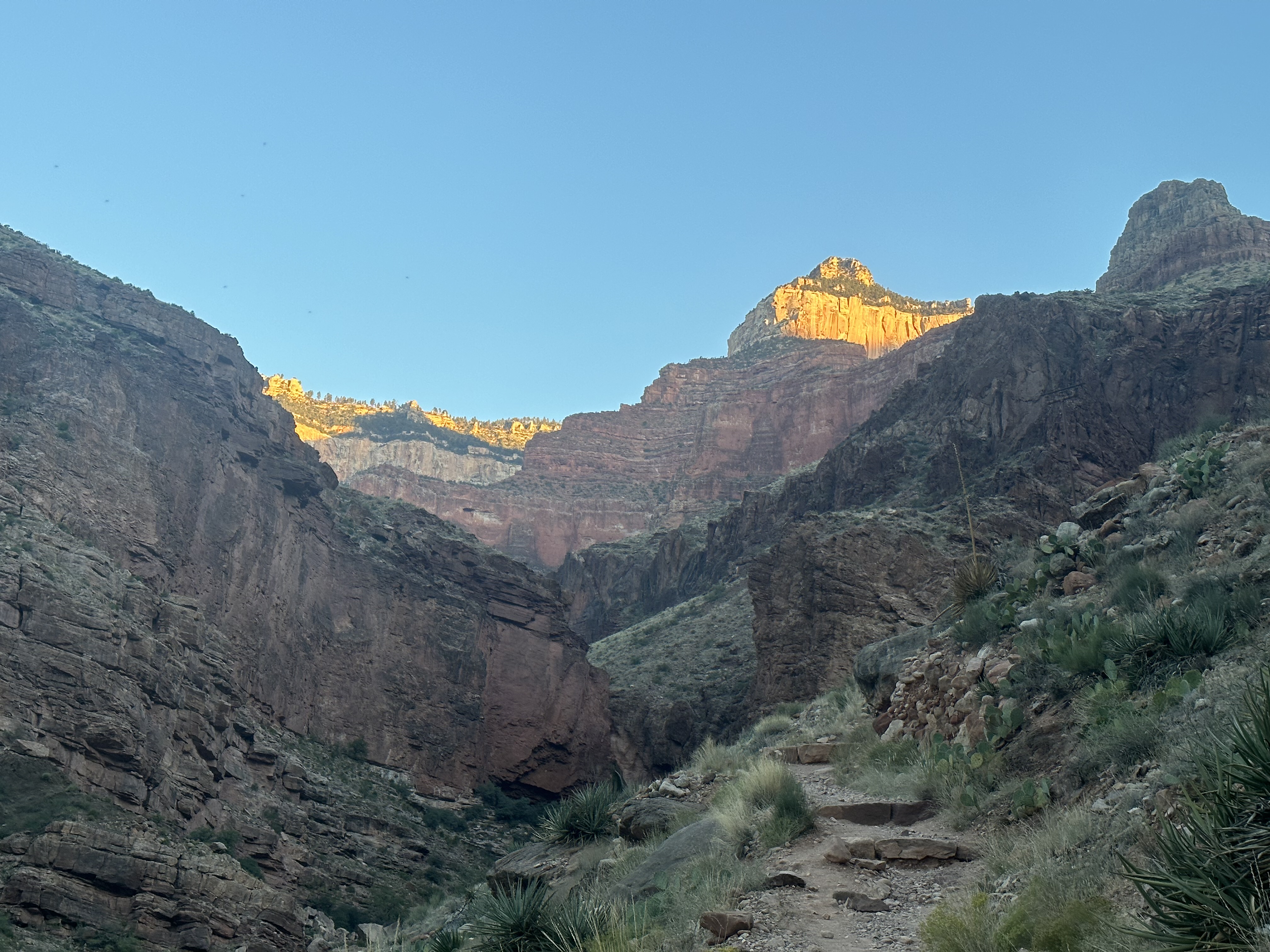
Grand Canyon, October 14, 2023, 3am. We found a parking spot near the trailhead and started out with our headlamps on. Passed a sign at the top that said something like: “Going down is optional. Coming back up is not.” I suppose I’d always known that. It’s why I put in the laps back in Minnesota. But seeing it here and seeing it in writing made it real. We took the first few steps down the trail and into the canyon. The hike down was amazing. Stars bright overhead. Few others on the trail. We reached Phantom Ranch just before breakfast. A friendly chef emerged and offered us two extra bacon and egg platters. What an offer—bacon and eggs at the bottom of the Grand Canyon, at one of the most inaccessible spots on the continent. But we turned him down. Our legs still felt strong after the descent, and at that point it was very early—it only takes a couple hours to come down the optional part. We were focused on putting miles on. Fifteen hours later, after we'd worked our way through our 30 plain tortillas and some energy bars, we'd wonder why.
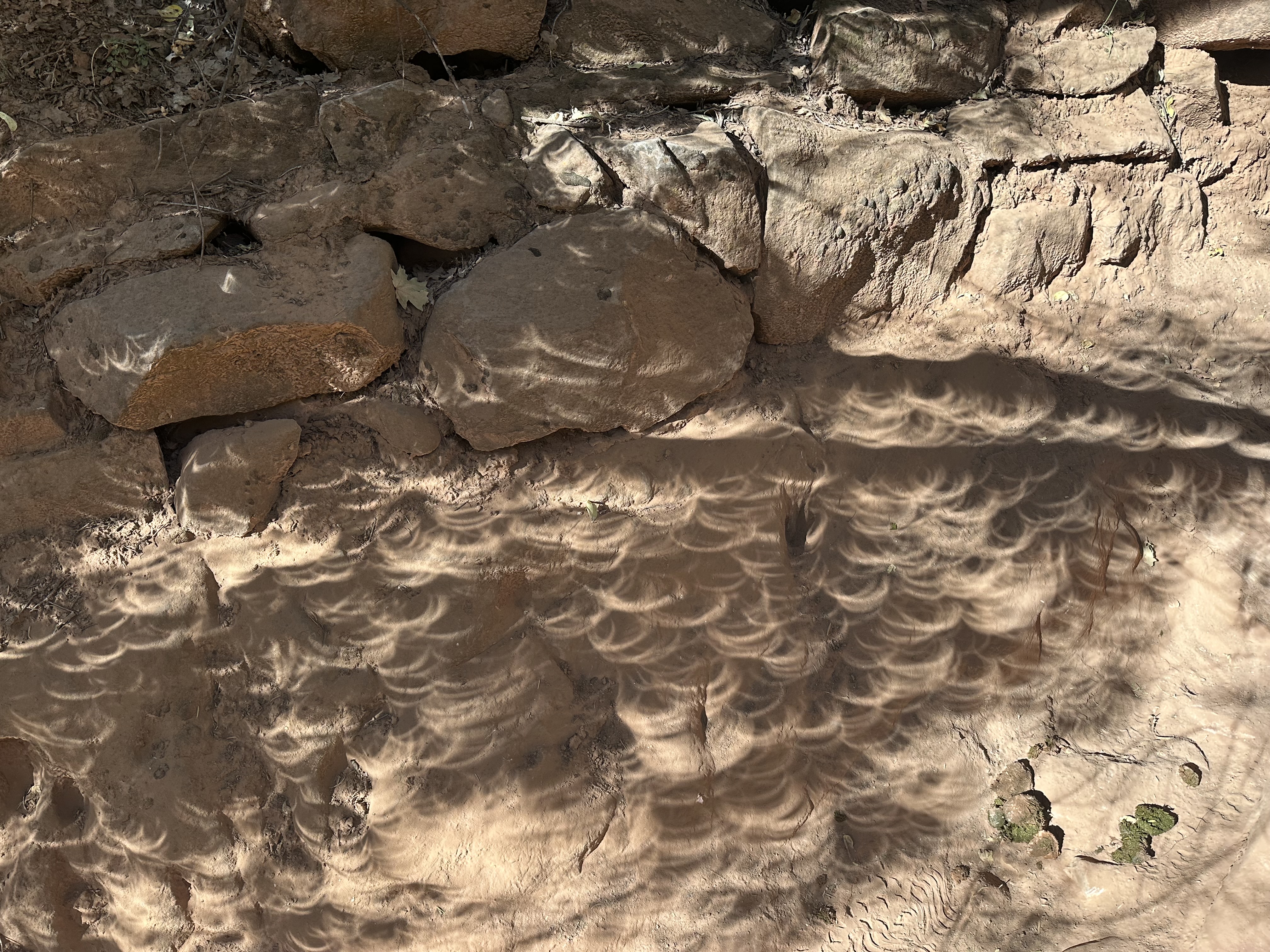
As the sun rose and we began the long hike across the canyon bottom, we saw there were actually a lot of people out on the trail—more than we’d expected. We began the climb out of the canyon on the North side and noticed small groups gathering here and there—just sitting around. Everyone comes to the canyon for different reasons, I thought to myself, I guess these folks are here to enjoy the views. Honestly, I didn’t think much about it. I was focused on rationing tortillas and keeping my heart rate in check. Finally, it seemed like the two of us were the only ones still moving along the trail. When a guy offered us his eclipse glasses, we finally understand the reason for the crowds and the strange behavior on the trail. We’d been so focused on getting ready, neither of us realized that there was a nearly complete solar eclipse—people had come from all over to watch here at the Grand Canyon. We stopped for a few minutes and looked to the sky with everyone else. Looking back down at the trail, I saw crescent shadows projected on the rocks from the sun passing between the small openings in the tree leaves. The views across the canyon are amazing, but those perfect little crescent shadows—that’s the image from the Grand Canyon etched in my mind.
We made it to the North rim, fortunate to get there without any twisted ankles or falls. There were a few people milling around and resting, having lunch, and filling their water bottles. Finding an open rock bench, we sat down for a minute and ate a couple tortillas. We’d decided to go without toppings, thinking the main thing we needed was calories. Once you've had about 10 plain tortillas, a little cheese or hot sauce sounds pretty good. Some hikers at the rim were done for the day. Others were halfway through their own journeys. One man had injured himself on the climb and was struggling to decide whether to catch a ride back or attempt the return hike. We could see the weight of that choice on him, but we didn't stay long enough to find out what he decided. I think we both understood the danger of delay—it was important to get back to the bottom before any second thoughts crept in, and before the sun sank much lower in the sky. A few hours later, we were back to Phantom Ranch, and as the sun set we walked through the campground past the campers sitting outside their tents and preparing dinners on little camp stoves. We sat down for a few minutes on a bench, talked to a ranger who had just finished a presentation on birds, and ate our last tortilla. Then, we crossed the Colorado and began the climb.
At this point, I knew we’d make it to the top. This was the reason for laps back on Inspiration Peak when it was just me and the chipmunk. While I didn’t dare acknowledge it, this was also the part that I was worried about. My mom was worried too. My cousins—strong athletes who’d done the river and back in two days—had asked serious questions. The rangers certainly don’t encourage rim-to-rim-to-rim (although they don’t say ‘no’ either). My brother, as usual, shrugged it off: “We’ll be fine.” Now we’d see if we were right about where our limits lie.
Climbing back out of the canyon—the part that isn’t an option—is over 4000 vertical feet of elevation along steep and challenging terrain. It’s a long way up and you feel every step. From the river, the trail ascends through sections of plateaus and switchbacks, each one heading the same direction—up. We were some of the last ones to cross the river before dark, and as we climbed we began passing others climbing on their own journeys. For some, it was a multi-day hike, for others down to the river and back in one day. Some had just gone down to the plateau for a good viewing point of the eclipse. Trail runners were out competing for personal best or FKT north to south R2R times. One guy we passed—we learned later—successfully became the oldest person ever to go rim to rim. A few, like us, were returning to where we started early that morning. I passed a lot of headlamps and heard a lot of encouragement in many languages as family members and friends pushed each other to the top.
8pm. As we neared the top, a zigzag of headlamps was visible slowly moving up and out of the canyon. There was cheering as each group made it to the rim. Finally, it was our turn—about 17 hours after we first stepped down into the canyon. We finished as we started, in the dark and under the stars—tired, but happy we’d made it. We were also still three miles away from our car. The Bright Angel, where we climbed up is at a different trailhead from where we went down at South Kaibab. We’d only vaguely thought about this portion and considered riding the park taxi. They didn’t answer, so we just walked.
The next morning, we drove back up to the viewpoint on the South Rim, surrounded by tourists from around the globe. We drank our coffee, took one last look at the view across the canyon, then started the journey back to Minnesota.